A US justification for attacking oil-rich Venezuela
a calculated insult to us all
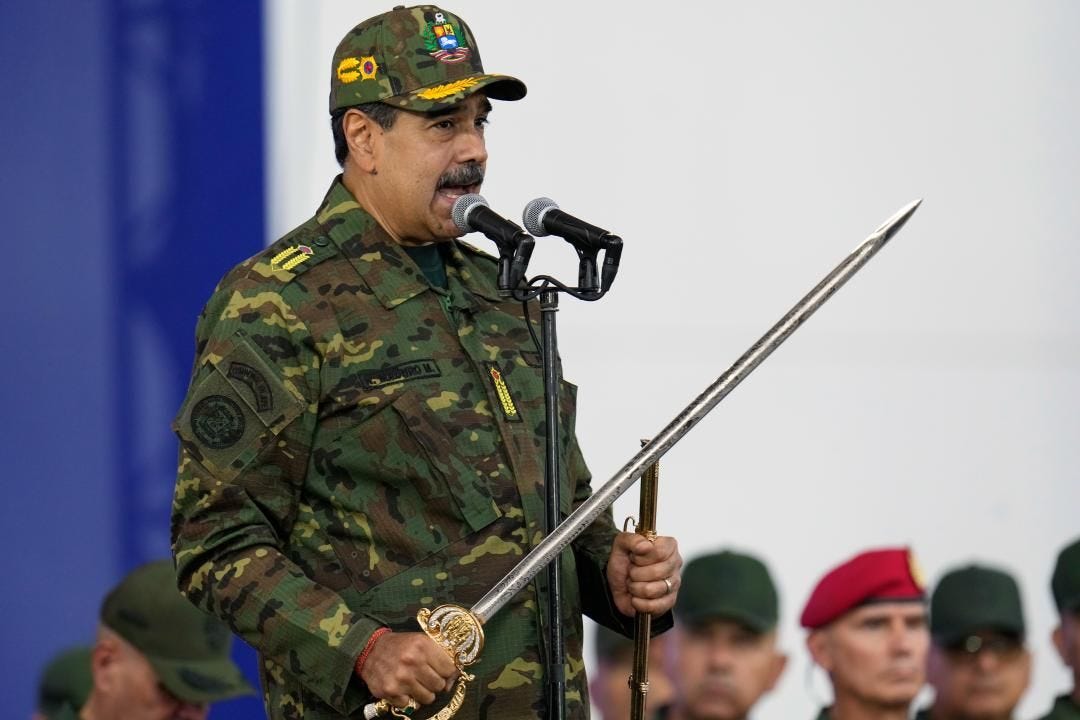
The current US strategy against Venezuela which, in plain terms involves serial murder on more than 80 counts on the high seas, internal destabilization, and the threat of invasion, is only the latest example of the antics of a rogue superpower.
How can this be?
The answer is simple. Australia, like every other nation state on the planet, shares a common status in terms of the rule of law – domestic and international - and mutual respect. We are irrelevant to whatever grand strategic purposes the United States is bent on achieving.
To the extent that Australian governments (and others for that matter) remain silent they debase themselves. Their ritual declarations of commitment to rules-based orders less an indication of a strong principle than merely a weak sentiment. Moreover, such declarations are unnecessary and cowardly, and very dangerous.
Unnecessary because what is on offer in this fiasco is the projection of an American psychosis - in this case concerning a widespread addiction to dangerous drugs - onto Venezuela (among others). When, in fact, beneath the ground, there is a vast resources wealth that dwarfs whatever substance processing and manufacturing takes place above it?
“Every boat we knock out we save 25,000 American lives… This is war…We are going to start very soon on land…. You’ll be thrilled to see that… These people are killing our people… They emptied their mental institutions into our country…”
---President Donald Trump, 3 December 2025.
This takes the form of delusions and disorganized thinking and is more a symptom of any number of causal factors in societies and organisations under severe physical and mental stress and trauma. Overall, the attribution of cause, or causes for the dire predicament, is (inevitably) “elsewhere”.
“American exceptionalism” assumes America’s essential purity. It is the non-American world that “infects”.
This is the stuff of fable. Or perhaps Madison Avenue without the sophistication of the Brothers Grimm or Hans Christian Andersen. Even then, the advertising agencies might pass on a contract that would require sanitizing the very special relationship that the United States has with the interface of politics and the world of drugs.
“The Navy admiral [Adm. Alvin Holsey] who oversees military operations in the region says he will retire in December…. Rep. Adam Smith, top Democrat on the House Armed Services Committee, calls for a hearing on the boat strikes.
“’Never before in my over 20 years on the committee can I recall seeing a combatant commander leave their post this early and amid such turmoil,’ Smith said in a statement of Holsey’s impending departure. ‘I have also never seen such a staggering lack of transparency on behalf of an Administration and the Department to meaningfully inform Congress on the use of lethal military force.’
--- WRAL News, 6 December 2025
Given this focus, if the literature (reports, sworn testimony, empirical evidence resulting from robust research) relating to the period since the entry of the United States into World War II is consulted, the immediate impression is that one is reading an extended narrative of a government-sanctioned global organized crime syndicate operating continuously for 85 years and counting.
Strictly speaking, a single focus rapidly reveals fractures requiring their own focus.
Thus - and this list is only indicative - the record reveals close relationships with (officially designated) organized crime and/or war criminals in the United States, Central America, and Central, South, and Southeast Asia.
In the research conducted by Alexander Cockburn and Jeffrey St. Clair on the infamous Operation Paperclipthat brought over 1,600 Nazi scientists to the US, the record is of the CIA and other agencies facilitating their transfer from Nazi death camp laboratories to the US where they worked on chemical and biological agents.
Some of those were subsequently tested, in breach of all relevant codes of ethics, on African Americans, and patients in mental hospitals.
The reasons for this enmeshment remain the same. It is either a case of supporting drug-running regimes to achieve a strategic advantage, or of acquiring a superiority in the use of drugs that can alter the behaviour of individuals, large crowds, or whole communities.
They are marked by four defining features.
First, all are self-destructive criminal enterprises, notwithstanding the attempts to legalize some of them. Second, all eventually qualify as “blowback” - the unintended and unwanted consequences of the covert actions in question. Third, the operational membrane between them is porous. Fourth, there is an inevitability to the confused analysis that attends these outcomes.
Consider the current situation which the US buildup in the Caribbean and off the Pacific coasts of Colombia and Peru.
Nowhere in Trump Administration pronouncements is it seen as an unsatisfied demand problem. Rather, the world is expected to believe that the crisis in American drug use is the result of an overwhelming supply, predominantly of opioids such as fentanyl to which American succumb in the hundreds of thousands.
Venezuela is named as a principal cause. And so must be attacked.
To believe this requires substituting the Trump administrations’ preferred reality for the substantial and relevant body of expert knowledge and understanding of drug production and distribution in Central America.
The region – which for current purposes includes Colombia, Costa Rica, El Salvador, Guatemala, Honduras, Mexico, Nicaragua, Venezuela, and Trinidad and Tobago - is widely described as a “narco free-for-all.”
The fast boats that are being sunk, and their crews which are being murdered on the high seas are not, however, even if carrying drugs, headed for the United States.
They have sufficient range to reach Trinidad and Tobago. From there, cargos of cocaine and marijuana would be shipped onwards to West Africa, Europe, and the US.
Fentanyl, manufactured from precursors imported from China, on the other hand, is smuggled into the US, mainly from Mexico and usually by US citizens.
Thus, if the source and distribution of opioids are the problem, and not the other forms of drugs, the wrong target is being attacked. Or there is an ulterior motive for the attacks.
This conclusion is underlined by the fact that, hitherto, the US has not deployed force at current levels in the Caribbean-Pacific area since the Cuban Missile Crisis of 1962. Also, by Trump’s decision on 1 December 2025 to pardon the former President of Honduras, Juan Orlando Hernandez, recently convicted after being extradited to the US and sentenced to 45 years in prison for, inter alia, partnering with cocaine traffickers.
Could the ulterior motive relate in some way to the fact that, beneath the ground, there is a vast wealth that dwarfs whatever substance processing and manufacturing takes place above it?
Indeed, a brief inventory of these natural resources is more than sufficient to place Venezuela in the same category as other lust-objects in President Trump’s gaze.
Consider their size and world ranking of known reserves:
Oil: 303 billion barrels, #1
Natural gas: 201 trillion cubic feet, #8 (and possibly #4)
Gold: 8,900 tons, #1
Iron Ore: 14,600 million tons, #8
Bauxite: 320 million tons, #12
Nickel: 28.9 million tons, #1
To this schedule should be added copper and coltan in amounts yet to be proven and/or certified.
“Venezuela’s dictator, Nicolás Maduro, says the real motive behind the massive US military buildup in the Caribbean is oil: his country has the largest proven reserves in the world.” The Guardian, 6 December 2025
It is here that scepticism must be accompanied by cynicism.
Can we assume that the rationalization offered for US violence against Venezuela – another chapter in the global “war on drugs” - is but a distraction from the underlying reality which is a blatant display of imperial self-interest, pursued by criminal means?
Fact and fantasy in the drug wars
The US “wars against drugs” conform to a familiar narrative. They are no more successful than its other, standard-issue conventional wars. In some cases they are far worse because they not only left the original problem unsolved, they exacerbated it.
But even this misses two points of extraordinary significance.
The first that has been made time and again and needs to be repeated. The historical record of the wars on drugs, mobilised by the US, and extending back to no later than the Nixon administration, reads not only as a litany of tragic failure, but a series of events from which the US seems incapable of learning.
In the 18 years that followed the administration of G.W. Bush, Mexico undertook the Merida Initiative – a massive military-backed operation to combat drug trafficking and its diversified organised criminal regimes such as money laundering, human smuggling, and oil theft.
The results are staggeringly negative. The cartels responded by mobilizing their own mercenary forces and fought the forces of the Mexican state in a form of hybrid war which, as of 2024, has produced 486,000 dead and another 130,000 “disappeared”.
The drugs continued to flow.
The second point of significance is that within the Special Operations forces which the US will deploy to initiate any attack on Venezuela are personnel who are themselves part of the problem, an old problem, merely updated.
Its bookends are the final years of the Vietnam War and the hangover effects in the here and now of over-extended, high tempo operations experienced by an influential minority within the 70,000 personnel charged with conducting special operations.
While the transit is from a conscript army to elite soldiers in an all-volunteer force, the comparison is linked via the need in both eras to escape from the everyday reality of operations.
In the former, an investigation mounted by the US Army War College over 1969-1971, revealed that, of US troops in Vietnam, 58 percent were using marijuana, 14 percent were using hallucinogens, and 22 percent (“epidemic proportions”) were using heroin.
Twenty-five percent of Vietnam War era troops were arrested within two years of discharge; 200,000 of the same veteran-cohort went on to become clinically defined drug addicts.
The numbers today are nothing like those, but the situation is parlous, nevertheless. At Fort Bragg, North Carolina, the largest US Army base in the United States, there is evidence of not only a serious drug use problem but also drug trafficking. Research on the latter – an entrepreneurial project run by a seemingly well organised and immune minority within the Special Operations forces - has been recently published by Seth Harp, a reading of which justifies his title: The Fort Bragg Cartel: Drug Trafficking and Murder in the Special Forces (Penguin/Random House).
It is crucial to understand the underlying causes, some of which will particularly resonate with readers in Australia.
In summary form they point to the forces and units in question being, essentially, a secretive elite, charged with executing highly dangerous missions in return for which they are indulged with and covered by layers of immunity from the standard regimes of military and criminal justice.
Worse, in some theatres such as Vietnam and Afghanistan, they operated in an exceedingly drug-permissive environment. Specifically, at the highest levels of government the drug trade flourished with the full knowledge, and effective consent, of the US political and military command.
The inference is that, in the furtherance of whatever strategic objectives had been decided, the creation of addicts among the military and abroad was an “acceptable” collateral cost.
During the US occupation of Afghanistan, for example, the country eventually produced nine times the total heroin production of the rest of the world.
It flowed at crisis levels to Asia, Australia, Europe, Russia, and the US itself. At the same time the US administration had narco warlords on its payroll.
Even within the military, however, there was an ample supply of officially prescribed potentially addictive drugs – such as dextroamphetamine (in the form of Adderall) – to allow them to cope with operational demands.
Overdosing as a form of coping with grief and pain became common. From there the recourse to opioids was/is almost “logical.”
The consequences are recognizable. At Fort Bragg, in the five years to 2022, there were 15,293 overdoses, and 332 deaths; 20 percent of the inmates in state penitentiaries, and 25 percent in federal penitentiaries were ex-military.
For Australia, these developments are the harbingers of danger.
They provide part of the backdrop for the accelerating growth of drug trafficking in Asia-Pacific which, coincidentally, is taking place at the same time as the expanding US presence in Australia, and the Trump administration’s predilection to decide on major strategic initiatives in isolation, and then to act unilaterally in the commission of major crimes on the high seas. Serial murder might be the least of these if the US attacks Venezuela.
Given the presence of the Joint Facilities, the growing US military presence in Australia, and the various and increasing joint exercises, Australia is in an inescapable position of vulnerability that is worsening by the day.
While it could not be predicted that President Trump would order similar actions to be taken by US forces in Asia-Pacific (which are linked to Australia), it is clear that, given his compulsion to order extra-judicial killings of suspects – murder remains an appropriate term - Australia would share the responsibility if not the guilt for the outcome.
Even if such events do not eventuate, why is there such silence in Canberra about events to date?
Is it because the commitment to high principle by the current (and former) Federal Government is only at the level of a sentiment?
Or is it that Venezuela and Venezuelans are sub-principle – and therefore not worth the possibly costly reactions that would follow from the White House should the Australian Labor government find a voice and backbone to question or even murmur about the “purposes” the US seems bent on achieving?
*
Earlier versions of this article were published in two parts in the on-line journal Pearls & Irritations. https://johnmenadue.com/authors/michael-mckinley/
Michael McKinley is a member of the Emeritus Faculty, the Australian National University. He taught Strategy, Diplomacy and International Conflict at the University of Western Australia and the ANU. He has also been a research scholar at the State University of Leiden, the Netherlands; Trinity College, Dublin; and in both the Department of International Relations and the Strategic and Defence Studies Centre of the ANU. He is one of only a few academics to have undertaken extensive field work in the area of international terrorism.
Your article is provocative and disturbing. As a non-violent activist I strongly believe we need to be informed… yet mainstream media seem to be increasingly curtailed. Has “reporting” become a dangerous business? I guess serious scholars are asking that.